Monday, July 31, 2006

Book Review

For being a relatively new field of interest, green computing certainly has had a number of books written on the topic. Here are two that I have found in my travels.

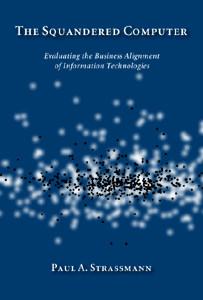
The Squandered Computer - This one apparently fulfills a prophecy from the Wall Street Journal in 1996, which stated:

"In the near future somebody will write a book about how executives in the 1990's spent too much money on information technology because they were afraid to manage it properly. They put their trust in technological experts to deliver business value from I.T. investments."

Ahem. Yes. This one is full of little horror stories about the pure madness of the situation.

Made to Break - Another fun little number that concentrates on the planned obsolescence of the whole shebang. Deeply examines how waste actually got started in america with safety razors and paper shirt collars in the 19th century.

Sunday, July 30, 2006

Open your Office

Solveig Haugland has a great how-to article on exactly how to make the switch from MS Office to Open Office. I love articles like these because they contain juicy information about how to actually make a sustainable change; not always easy when you are implementing a complete new system.

Measuring your Green Success

Sometimes sustainable computing is considered to be a buzzphrase for IT management. The argument goes like this; sustainability is a concept that deals with the social, environmental, and economic aspects of a given process. However, in fact what you have just described is what our IT management team does, we look at all these factors on a daily basis and make changes to the organization as needed. If we find new ideas, technologies, or processes that we determine are beneficial to the business, we 'in-corporate' them to our model. 'Sustainable Computing' is what we have been doing as long as our IT management team has been around.

Of course, this position is valid. In fact many of the easy sustainability changes can be pitched to management right along these lines e.g. getting IT to pay for the electricity they use, double-sided printing, recycling of used equipment, etc. These are items that save money and don't affect the quality of service enough not to implement.

But the necessary part is incorporating the sustainable principle into the metric that the department evaluates itself on. As this article from CIO explains, all too commonly the only metric used to evaluate performance is IT spending as a percent of revenue. The shortcomings of type of measurement are many; most salient is the fact that the budget for maintenance and the budget for R&D is collapsed into a single number. And this is where a sustainability guidelines can help out the most, by recognizing that maintenance needs to be minimized so that other programs such as research, innovation can be maximized to furthers the aims of the business. And I'm not just talking about fixed broken machines here, I'm talking about all maintenance - user problems, hardware issues, licensing schemes, environmental footprint, etc.

Want to measure your sustainable computing program? Measure your maintenance.

Woody Two Shoes, Redux

I posted a while ago about a fellow who made beautiful handmade wooden monitors and mice. I had no idea so many people were in on the game - EcoGeek has the definitive guide on all computing products wooden. There is all sorts of stuff here, Russian-styled computer cases, Swedish Ikea-style monitors, a whole line of Bamboo items, and this beautiful one of a kind "Sangaku case mod" which took over 300 hours.

Obviously it's a idea that is high on the niftyness scale; while we don't need to cut down the rainforests to prove we can make wooden computer parts, the elegance of these items is unshakeable.

Friday, July 28, 2006

Lock me in! Lock me down!

The WRT54G Router is something of a novelty as the firmware is Linux-based and open source. Unfortunately, recent versions of this model have a closed source firmware based on VxWorks. Hackers are calling foul - why go back on such a great thing?

The relationship between hardware and software vendors has always been interesting. Sometimes they "coopt-lude" so well that they Juggernaut; Wintel, for example, comes to mind. Other times it's nothing but the rawest form of power, pure reward and punish behavior. I once owned a Dell that could run nothing except Windows 98, because that was the only driver that the NIC supported. It keeps you locked in to the same set of vendors, and it keeps you locked down from too much horsing around.

There has been a few interesting hardware companies, such as Roomba, that have made interfaces to their operating systems available and opened them up. (Incidentally, I went to high school with one of the founders.) I wonder if we will see more of this? Imagine an open source washing machine where you could modify the code to do what you wanted it to, maybe some specialized cleaning job like washing loads of sneakers, or maybe for a different use entirely. It's a pretty exciting idea.


Wanna be somebody else? Change your mind.

Martin Veitch has this nice article that summarizes an ongoing battle that sustainalists have with executives. The argument has three parts, (a) saving the enviroment costs money (b) it's bad policy, and (c) the money by 'going green' amounts to nothing. I'm convinced these arguments come from the 1970's when Earth First was using thermite to melt bulldozer engines and naked hippies were chaining themselves to redwoods. These are strong mental images. Saving anything green meant paying for items that could be externalized, and even if you did do the analysis the savings was either over too long a period (more than three years? forget it.) or was dinky and could be racked up to CDB.

Martin dissects this in a honorable fashion by pointing out that the world changed over the last 30 years. It's a quick read.

A Flippersmack to the head

This is one of those articles that summarizes a topic so simply that after you read it, you have an 'aha' moment. The topic is 'Why are there desktop computers still around in business?'. I don't want to give it away, but this was the part for me:

The once mighty PC is seen as a threat, vulnerable to trojans and viruses that spread to other PCs across the network. The dominance of software licensing schemes further exacerbates this growing view that a business desktop PC is dangerous and burdensome.

Today we lock down these PCs, control them through a central IT group and call them "managed desktops." Ironically, and almost laughably, today the personal computer in business is nothing more than a storage of applications that require licensing schemes and are controlled by a central server.

Ah, the arrow of truth. Much like wireless hotspots, I can envision a hotspot network of linux terminal servers set up by people that people just connect to with their diskless client where they can surf, maybe do a little open office.


Library

I come across lots of good reports, white papers, etc. that have a lot to say about some aspect of green computing. I thought I would post a bunch en masse.

Analysis of the Impact of Open Source Software - A good read about where OSS is giong and how much you can save by implementing it.

Sun's position paper on sustainable computing - Sun has the best strategy going on sustainable computing. Even you you don't use their equipment, it's a must read. You probably will soon.

Thin Clients - several white papers on thin clients.

Thursday, July 27, 2006

Woody Two-Shoes

Wood Contour offers a whole range of wooden peripherals for your computer. Their items are truly beautiful and the craftmanship is impressive. They are not cheap - the monitor shown is $395 - but they have their place. Just drop one on the receptionist's desk to make a statement.

One Big Happy Family

Why does technology cost so much? Well, ten years ago it costs a lot because the advantage of switching the technologies was so great that companies could and would and did charge a lot for it. A lot of typing pools went out of business, click-clack.

Now it's a little different because everyone is pretty much on the same playing field. We all made the switch, at least to some degree, to take advantage of the massive efficiencies in computing. But it still costs a lot of money - according to this article, between 1 and 10 percent of most budgets. And what are they spending it on? Maintenance. You know, fixing stuff that breaks. This is about 80 percent of the typical IT budget. And you know what, here's a big secret. It's boring.

Which brings me to my point about the One Big Happy Family, I'll call it the OBHF. You can't get your company to the OBHF model if 80 percent of what you do is boring, expensive maintenance. First gradually, then permanently, this will cast a long dark pall over your IT organization until there is no room for any innovation in the computer room. My point here is that this is related to the social side of sustainable computing; when people find technology boring and expensive, they will stop using it, and that's really no good for anyone. So it's really pretty simple, just eliminate the maintenance and save the company.

Wednesday, July 26, 2006

One Thin Client Per Child

I love the one laptop per child project that MIT is running. I can remember the first time I looked at Yahoo using a text-based web browser and remembering having this mind opening experience. This overwhelming sense that, wow, this Internet thing would change the world.
Unfortunately, not everyone is agreeing, as India has just opted out of the One Laptop Per Child program. Education Secretary Sudeep Banerjee summed it up, saying:

"We cannot visualise a situation for decades when we can go beyone the pilot stage. We need classrooms and teachers more urgently than fancy tools."


I don't know if I agree with the statement or not; what it does call into question for me is appropriate use of technology that is sustainable. Lots of companies have no problem spending money on technology - it's the future, we need to compete, etc. But here's a entire nation that is essentailly saying "we are not going to spend $100 dollars for universal access to one of the most basic forms of technology." It makes you wonder.

Tuesday, July 25, 2006

Thanks for the Free Money

It's a rare individual who can actually flush a twenty dollar bill down a toilet. Go ahead, try it. I bet you couldn't do it. The reason is that most people don't take the real cash and waste it, they have to convert it into something else that they have an easier time wasting. So, go buy some plastic forks and knives - see how easy they are to throw away? Go buy a magazine, read it a few times, then trash it. There you go, that's 5 or 6 bucks right there. You're doing fine.

How about this one. Go become an IT manager who is responsible for 10,000 desktops. Mandate a two or three year cycle for equipment, then when the cycle comes around just start throwing perfectly good computers in the trash. The working monitors too. Just throw it all away and buy brand new stuff, and when you do it put the latest Wintel operating system on them too, which surprisingly didn't run on your two year old equipment. Sounds Nuts? It's absolutely standard business practice.

Enter Newmarket, a firm that takes all of this gear and then resells it. They just received $50 million in venture capital funding to expand their business. The refurb market is hot, and huge - it's a $1.5 billion dollar business that is growing at 45 percent annually. Just to give you a sense of it, Newmarket processed and resold 1.3 million units last year; Dell alone shipped 37 million.

There's some story about a fool and their money which I'm recalling right now. I'm can't remember how it ends, I think I'll Google it and see.

Monday, July 24, 2006

Amory Lovins, on the war path...

to set the record straight on actual electricity usage for computer nationwide in the U.S. In this article (from 2001) Amory claims the 8 to 13 percent number to power our computing infrastructure that I often hear is not quite right, it's a confabulation the Western Fuels Association. In reality, the number is more like 2 percent. Is it true? I'm not sure, my impression is that it probably was at the time (2001), but now it is probably out of date. But how out of date is the question.

Perhaps this article from CIO has the part of the answer. Lovins claims a racks of servers in 2001 used 30 to 60 watts per square foot. however, CIO mag states that:

...a rack of servers installed in data centers just two years ago might have consumed 2 kilowatts and emitted 40 watts of heat per square foot. Newer, "high-density" racks, which cram more servers into the same amount of space, are expected to consume as much as 25 kilowatts and give off as much as 500 watts of heat per square foot by the end of the decade.


So, it loooks like it was stable for a while but now is rocketing upwards. This doesn't seem to mean too much - more dense servers obviously means more power consumption - and of course the data center is the whipping boy for the whole power/computing debate as a whole.

Some projections seem a litte nuts - 50 percent of our energy budget towards cyberinfrastructure by 2020. RAND seemed more realistic in 2002 with 5 percent, but quality and reliability will outpace the cost of the electricity itself.

Silver and Gold, Silver and Gold

EPEAT now has some products in their database. For those you you not in the know:

EPEAT is a procurement tool to help institutional purchasers in the public and private sectors evaluate, compare and select desktop computers, notebooks and monitors based on their environmental attributes. EPEAT also provides a clear and consistent set of performance criteria for the design of products, and provides an opportunity for manufacturers to secure market recognition for efforts to reduce the environmental impact of its products.

Right now, they only have 69 products that are rated according to green computing standards, and none of them are rated 'gold'. I'm sure the number will blossom in the next few weeks - it will be interesting to see how it it affect purchasing decisions, and how much news coverage it will get. HP and Dell are already getting coverage.

P.S. The title is from yet another movie, actually, a song from a movie. See if you can guess.

Sunday, July 23, 2006

Is this funny?

I'm finding that I like to quote old movies in these posts. The title for this one comes from "A Few Good Men" Cruise is questioning Nicholson 'bout his involvement in the 'Code Red' and asks "Is this funny?".

His answer, at the end of this post is reminiscent of what's happening with the power supply this summer. Numerous brownouts and blackout have already been reported including the following:

TVA

Queens

San Diego

St. Louis

With computers using 8 to 13 percent of the US power supply, you can bet that some business are taking a beating. "Is this Funny?" As Colonel Nathan R. Jessup responds "No, its tragic".

Saturday, July 22, 2006

More Green Hosting

These guys are another green web hosting agency with a nice package. Starting at 50 pounds a year, they will also plant a tree on your behalf, have solar powered offices, and are paperless to boot. I think this is affordable enough for folks to start competing with traditional hosting. Coupled with a business marketing plan that wants to make an eco impression for their customers, it's a good bet.

Friday, July 21, 2006

Three's a (virtual) crowd

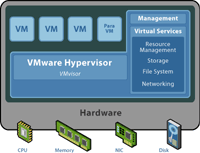
Vmware, a popular developer of virtualization software, is calling foul on the recent deal with Microsoft and Xen to allow virtualized servers to run on Windows. Calling it a "one-way street", Vm points out that the agreement only allows Linux to run on Windows through Xen, not the other way around. Of course, it doesn't mention that Vmware won't be virtualized in any way, shape, or form under the agreement.

Is it a slippery slope? Could be, could be, Microsoft is certainly adroit at getting in the thin end of the wedge. It could also be a misdirection to expand into other turf of other competitors, say, Google.

My guess is that this is going to open up a Pandora's box where something totally unexpected is going to happen, because virtual environments promote these sorts of things. Someone is going to find a twist that completely subverts the intentions of this deal. What will it be? I don't know. Maybe someone finds a bug. Maybe Apple, maybe Vmware, comes in with a great idea that uses the technology to host iTunes, or World or Warcraft. Who knows, something. Something unexpected. Watch this space.

Thursday, July 20, 2006

Keep out of the Pokey with Thin Computing

It's nice to mix it up by adding in some articles on sustainable computing that deal with the social aspects. Generally, these are the ones that get the boardroom to respond. Steve Kaplan has a nice article here on how the Sarbanes-Oxley Act can push companies towards the thin client solution. He writes:

Beyond providing an environment much more conducive to satisfying Sarbanes-Oxley, a thin-client architecture also makes far more economic sense than a distributed computing environment. For instance, individual PCs no longer need upgrading in order to accommodate more resource-intensive applications or operating systems. Remote offices generally do not require servers, tape backups, UPS devices or network administrators. And the requirement for PC-support technicians goes away (if a PC breaks, it generally is replaced with an inexpensive Windows terminal that has no moving parts at all and a meantime between failure measured in decades).


I've said before that there sustainability is composed of three parts - economic, social, and environmental. Steve's suggestion is a win, win, win.

Wednesday, July 19, 2006

All these Whirring Blades

Now here's a novel idea, Pembina is offering wind power certificates to offset the electricity that your computer will use. It seems like you pay them to balance the carbon offset of the power that your computer will use over the course of your laptop or desktop's lifetime. The figures they are using to caclulate emission seem low - 30 watts for a laptop and 120 watts for a desktop which they got from Tufts University. Doesn't seem right, with the new processors from Intel and AMD coming in by themselves between 160 and 192 Watts. This puts the typical system up in the 250 watt range.

Tuesday, July 18, 2006

Pressure and Time

Kelvyn Taylor lays it down for us, describing exactly what it is going to take to get sustainable computing into the mainstream. Kelvyn takes the position that things will eventually change when consumers start demanding the green product. I'm sure this is a major part of it, not that anyone is running out and asking my opinion right now.

But the other part is the waste. Taylor sums it up here:

Mention environmentalism in relation to IT and it’s usually a debate about a CPU’s power consumption or clever power management modes and recycling scams. But as I found out after following up some of Diamond’s references, the total energy consumed during a PC’s lifespan is only about 19 percent of its overall energy impact – the rest is used during its production.

All too true, especially the part about 81 percent of the energy in computing being used to make the iron. That's about ten times of the weight of the PC, probably the most wasteful thing in common use on Earth. Cars have a 1:1 ratio.

I read an article about transportation a while saying that planes will be the first thing to go, because flight is so fundamentally costly. There's a lot of evidence that that is the case, with national airlines folding and a lot of the US ones in bankruptcy. Could the computer be the first thing to go? More importantly, and I don't know the answer, how can they be so cheap?