 Nigeria seems to be full or surprises these days. First they buy 1 million of the OLPC laptops, and now coming up with a computer that uses only 8.5 watts. Pretty cool, except it costs $1200 dollars. Maybe it's the classic scenario of paying what you want to get what you want. Linked from Gizmodo, because their write up gained my highest accolades.

Monday, August 14, 2006
How Low can you Go
Nigeria seems to be full or surprises these days. First they buy 1 million of the OLPC laptops, and now coming up with a computer that uses only 8.5 watts. Pretty cool, except it costs $1200 dollars. Maybe it's the classic scenario of paying what you want to get what you want. Linked from Gizmodo, because their write up gained my highest accolades.

Sunday, August 13, 2006
Monkey Time
 We all suffer from cognitive bias, the human ability to disregard the facts completely and instead rely upon some other sense to make decisions. There are tons of biases, and a lot of them come into play when we deal with computing.
 In particular, as illustrated by James Boyle, these biases crop up in decisions regarding open source software or collaboration learning environments such as Wikipedia. We simply have no genetic basis upon which to make decisions regarding these tools. Take open source, for example. It's essentially a bunch of projects put together by people who mostly expect nothing for their time, and in their off hours they are going to build something fantastically useful. Doesn't that sound nuts? Or how about Wikipedia? As Boyle describes it:
Set yourself the task of producing the greatest reference work the world has ever seen. It must cover everything from the best Thai food in Raleigh to the annual rice production of Thailand, the best places to see blue whales to the history of the Blue Dog Coalition. Would you create a massive organisation of paid experts with layers of editors producing tomes that are controlled by copyright and trademark? Or would you wait for hobbyists, scientists and volunteer encyclopedists to produce, and search engines to organise, a cornucopia of information? I know which way I would have bet in 1991. But I also know that the last time I consulted an encyclopedia was in 1998.
Most of the things I love about the Internet are the things that really are impossible without it. Here's a great example from my personal life. When I was wee, I collected these trading cards called Wacky Packages as a kid. I loved them, but my mom threw them out, and I thought about them for years. Then eBay came around and I found out I could actually collect these cards again - what a thrill! Open source and Wikis are the same thrill, but you have to get out of your genetic jungle to see what they can do for you.
Do My Bidding
 Fat Knowledge has an interesting analysis on how many 'energy slaves' each American has working for them on a daily basis. An energy slave is defined to be some machine using the equivalent amount of calories that a typical American would use in a day (typically about 2200) The article will tell you how many, it's surprising (a three digit number).
I did my own conversion from 2200 calories, turns out it also equates to about 2.55 kilowatt-hours. That's rougly the energy to power a single PC for a single day. At that rate, I'm amazed that computers taken over the world yet; it certainly helps to explain their proliferation. At this rate Bill Joy is right, the future doesn't need us.
Electricity has long been the servant of the industrialized world. It has been cheap, abundant, and reliable. It's amazing the attiudes this cheap energy have created, and PC usage is one of them. It will be interesting to see what happens as the price of energy rises - will we keep the machines turned on, or keep the people employed? This is the sort of decision that has been made for decades in developing nations, but it will be a surprise for the developed ones.
Saturday, August 12, 2006
CIO Insight is on the Bus
 CIO Insight has just devoted a good part of their July 2006 issue to a discussion on green computing! I feel great that such a prominent mag is on board. The feature length articles concentrates a lot on energy and a little recycling and it is well worth the read.
Thursday, August 10, 2006
Green is My Grid
 Grid Computing is up and coming form of technology that uses many networked computers to model a virtual computer architecture that is able to distribute process execution across a parallel infrastructure. Wow. It's an interesting idea to soak up all of those extra computing cycles from all over the world, or from a data center that has a few billions extra cycles per second. The Green Grid is a fine resource that describes the concept in more depth. Also, there is a good list of distributed computing projects on Wikipedia as well.
Wednesday, August 09, 2006
Virtualization puts a fright in Vendors
 Virtualization must be heating up, as Microsoft is making some changes to its licensing policy. Business customers can now run up to four instances of Windows on the same PC, which will be a help to cut down on hardware costs. Unfortunately, most of their software (Office) is still licensed on a per client basis, and if you use Windows for your thin clients to connect to your virtual server, that is another fee. Looks like Microsoft is still in the software business.
What I would really like to see is pooled licenses for applications and pooled licenses for virtual server access. This would allow for corps to ramp up and ramp down according to user's demand. This is what green computing is all about, just enough computing power at all times to do the job.
One Eye on the Flag
 I don't think I'm telling anyone new news when I say that most entities are switching to open source because it saves them money. Brazil, Spain, Norway, China, India, there's a whole list of players that are really interested in saving multiple millions from doing the switch. Guess who is pretty far down the list - The United States.
You know why these 'foreign governments' are switching to open source? A popular reason that is given is that they are unhappy with "the US lead in the software world." Frankly, I'm not quite sure what that means exactly, but it strikes me as somewhat nationalistic. It got me thinking - what if all of my desktops were running an operating system that came from Honduras? Honestly, I don't think I would like it either; too much control, too many dollars going out of the country.
The overall effect is that foreign nationalism actually pushes them in the more sustainable direction, while our nationalism pushes us in less sustainable direction. So when you are considering a change to Linux or any open source product consider this as well - are you swayed by going the Microsoft direction just because Microsoft is an American company? If you are, that eye on the flag might distract you from the bottom line.
Tuesday, August 08, 2006
Vickedly Vacky
 Germany has just decreed that you cannot sell used software licenses. You might ask why I care - sustainability wise, there's really no real cost to producing the copy again. Aha, that is true, but this ruling and others like it will tend to push the consumer into buying the latest version of the software, and I think that might be an unsustainable thing. For example, do I really need the latest version of Photoshop, or can I get by with version 6? Is word 2005 a necessity, or can I use Word 2000? Fact is, these latest and greatest versions require Bigger Iron, which may mean a new computer. Of course, it may also push users into open source solutions as well.
Nighty Night
 Power managment for desktop PC's is something that has been around a while. Turns out that there are now several companies providing software that helps you to reduce power usage when your computers are not in use. Power wise, a well managed computer can save between 25 and 75 dollars per year according to the EPA. I know, I know, it's nothing. Read my earlier posts.
The piece by Madison Gas and Electric reviews almost every package out there. Looks like Surveyor, by Verdiem seems to be the best of the bunch, I think it's about 20 dollars per machine. Others include Nightwatchman and two free tools for the EPA, EzSave and EzGPO. Really, there is really no reason not to do this. Read the great case studies at the EPA site.
Monday, August 07, 2006
Go and Sin no More
 This double header by Jon Udell and Tom Yager from Infoworld is invaluable. I often spend a good deal of my time in high powered meetings trying to convince top staff that they can make their IT systems more efficient, and save the environment as well. Inevitably, what I seem to run up against is, as Yager call it, 'Religion'. He summarizes as thus:
It's hard not to become attached. There is comfort in reducing decisions to simple equations such as "PCs come from Compaq" and "enterprise software is written in Java." Bosses associate quick decision-making with competence. But when you make choices from prejudice, you're not just wasting your company's money, you're cheating yourself out of one of the better fringe benefits of working in IT: the delight of constant discovery and learning.
We all know that sometimes people get downright zealotic about certain IT things, and we know that the man in the mirror is also to blame. But moving to a sustainable computing environment requires a losing of the religion. It requires objectivity. And it requires being able to defend a long standing position better than "PCs come from Compaq". Not good enough.
Which is where Udell comes in. He recommends two books, Breaking the Spell and the Selfish Gene is suggest ways to model these types of reactions and work with them. Religions, for example, fall apart when put under the eye of the group lens. Perhaps the introduction of a corporate blog or wiki would help break down these old patterns.
Beat the Heat
 Telecommuting is a topic that I haven't discussed yet, but in fact is very dear to my heart. TC is intriguing because is has great potential to be the 'silver bullet' for sustainable computing; it cuts down on gas consumption, co2 emissions, downtime and if properly designed, computer equipment.
 Is also helps keep people working in the midst of heat waves, when your employees' cars overheat, or the local electric company pulls the plug on your business because you use too much electricity. Overall, it cuts your overhad bills and reduces the need for office space. More to come on this exciting topic.
Sunday, August 06, 2006
Here Comes the Pitch
 Selling is really nothing more than putting your goods and services into the hands of the people who need them. Really good salespeople are really good listeners, and are adept at finding out what people really want and giving it to them. Really bad salespeople are really bad listeners, and are constantly trying to tell the customers that what they want is what they have.
 Virtually every hardware and software vendor has a policy related to green computing. This policy is really a sales pitch - this is what they think you want. This is a great system, except it relies upon one thing; you knowing what you want. Because if you don't know what you want out of a sustainable computing solution, you are apt to make bad purchasing decisions. Moreover, you are more likely to fall for a bad pitch, as the salesman will be trying to tell you what you want.
There are a lot of factors involved in making these decisions including costs, corporate image, user skills, etc. If you are commited to any sort of sustainable computing initiative, you should take the time to identify your priorities. Think that reusing equipment is the way to go? Read the Rethink policy from eBay. Want commit to eco-friendly hardware for marketing purposes? Examine the EPEAT registry and the policies of the big manufacturers. As usual, it will be rare to find a pitch from a company that doesn't benefits their own interests as well. That's fine, just make sure they are your interests. For example, if you are committed to moving to a thin-client solution, don't be persuaded to buy more desktops or maintenence contracts from Dell as they change their business model because they are losing money. Because as the sustainability battle heats up, there will be a lot of pitches, and its easy to go down swinging.
Saturday, August 05, 2006
Linux and Cosa Nostra
 Does "the mob" run Linux? Well, they certainly don't on the desktop, at least not yet. Today we are investigating why this is the case, and whether this is a good for "Cosa Nostra" - literally, "Our Thing", which is of course green computing.
Let's start off with a survey from Desktop Linux that queried 3300 users about putting Linux on the desktop. The purpose of the survey was to determine the drivers and barriers to getting Linux installed. The results were interesting; the most important reasons were that employees were asking for it and competitors had already did it. TCO was third, then licensing costs, then security. Unfortunately, the survey did not probe the deeper motivations as to why users and companies want to switch, which doesn't give us a lot of clues in terms of a sustainable computing model.
However, I think we can infer a few results. First, the fact that TCO and licensing costs were on the survey at all suggest that these are reasons to switch, and in fact these two did well in the rankings. So it's cheaper; that definitely means more sustainable since the environmental costs of the "virtual thing" Linux is nil. Secondly, the survey is designed to compare one operating system to another, not one computing architecture to another. I think we can assume that the respondents are keeping everything else the same - same network, same desktop computing environment, same file servers, etc - and then replacing Windows with Linux. So, is this configuration 'more sustainable'?
My answer would be no. Definitely no, because nothing else changes. The energy use is the same; so is the recycling fees, the three or four year obsolescence cycle, the personnel needed to support the desktops, and the needs for all the other network infrastructure that you currently have. You save on licensing fees going forward but your existing license fees are sunk costs. So, short term, it's a complete bust. You're not in the family yet.
Long term, you can be if you are willing to stay with the program. Switching to Linux can be part of the program because it extends the life of your desktops. Long term, you stop paying license fees. Long term, you can use a Terminal Server to centrally manage your desktops applications, which will also all be free. Long term, you can reduce your IT staff to manage this. Long term, there's promise if you are willing to make many changes. But just switching to Linux on your desktops will not make you a Made Man.
Thursday, August 03, 2006
Crystal Ball
 Moonbase is making some prognostications about the future of programming in the next ten years. On top of the list is that energy consumption will dominate computing. Here's the energy list:
- The notions of optimizing for speed and optimizing for power consumption will begin to converge.
- Energy efficiency will become a selling point for all “consumer” computing devices (not just battery-dependent ones).
- We will see the beginnings of hardware and software infrastructure for energy accounting similar to that available for CPU time. This includes profilers.
- Fine-grained billing for use of computer resources will make a little bit of a comeback. People will still prefer flat rates.
- “Ubiquitous” computing will become popular in developed regions, but energy economies of scale (and a desire to avoid contact burns from high-powered portable devices) will be a selection pressure towards a network of just-dumb-enough nodes and centralized computers.
- Many things will turn out to be cheaper to do than to simulate.
Wednesday, August 02, 2006

United we stand, for eWaste, maybe.
 Looks like the Federal gubberment wants in to get in on eWaste policy. The report acknowledges that state by state Waste recycling is a patchwork of fundamentally different systems composed of fundamentally different methods of disposing and processing the waste.
The report is comprehensive, about the only thing not covered in the report is how to pay for the program. It will be interesting to see where this leads - will they charge the manufacturers, the consumers, do it for free? I've got my bet down. (hint: it's not the free option.)
The Roi Hath No Clothes
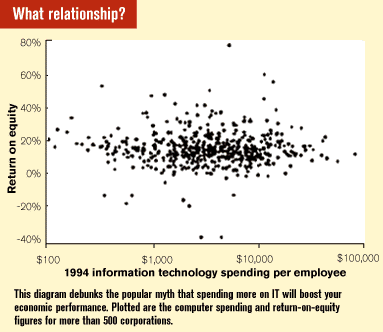 Picking up from the Squandered Computer, I happened across several articles that suggest IT investments are overrated. The scatter plot at right shows spending per employee and return on equity for over 500 companies. See the trend there? Basically, no matter what you spend on IT, your company will probably only get around 20 percent return on investment.
When you talk about any sort of serious investment for a firm, the chatter almost immediately turns to ROI. People love ROI, ROI is the king in purple robes when it comes to any major business decision. In fact, Roi means 'King' in French. Those French, they really know how to put together a language.
Roi is king, except when it comes to IT spending. In IT, the Roi is running around bare-ass naked with fistfuls of dollars. Some soundbites from the Squandered Computer merely drive this home; 31 percent of all computer projects are cancelled, 58 percent go over budget. In 1995, US corporations spent 500 billion on computers, which exceeded their profits by 175 billion. Why is Roi so unfettered in IT? For starts, it's almost never done, as it is is often perceived as too complicated to do. When it is done, it is almost always done badly, either by lumping all IT spending into one category or by using the wrong metric (e.g percent of revenue) to evaluate the program.
What really needs to happen is that return on investment calculations need to be done on all forms of IT spending, and it needs to be done right. IT maintenance costs need to be fully accounted for (energy use, recycling fees, etc.), and they need to be separated from strategic and tactical initiatives. If this is not done, companies will simply give up on strategic and tactical spending. This would really be a tragedy, as there is still of lot of opportunties left in computing and only the corporations who start doing it right will be able to grab them. The rest will be saddled with 80 percent of their IT budget going towards maintenance of existing systems, lumping along towards doomday. Simply put, if you don't do the Roi, you won't have jack.
Tuesday, August 01, 2006
Oh, Joy
 Leaders do things that are new. The problem with being a leader is that you are often poorly understood because, almost by definition, you are one of the few people who understand the potential of your idea. Then you somehow have to convince the managers, who are focused on the current business processes, to give the new idea a go. This can be a really hard thing to accomplish, because try as you might the managers will not see the idea. Almost by definition, they can't.
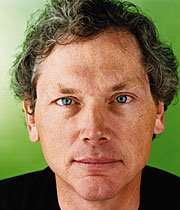
Unless you happen to be Bill Joy. You know, wrote Berkeley Unix, started Sun Microsystems, blah, blah, blah. In this interview with Maria Bartiromo, Joy proclaims that green is the next big thing. The next wealth creation thing. The next MONEY thing. So when you are trying to push your green sustainability ideas to the higher ups, just say "Well, Bill Joy thinks that going green is the next opportunity for massive wealth creation." It can't hurt to have Bill on your side, and it might just help.
Smelly Gold in Smelly Hills
 Classify this one as 'Recycle'. Landfills are starting to look like mighty appetizing hunting grounds for metals, particularly copper and gold. Why? Well, eWaste is just full of these riches; according to the article, one ton of scrap from discarded PCs contains more gold than can be produced from 17 tons of gold ore. Although landfill mining been tried for years (mostly without success) the big driver will be the energy costs to process virgin ore. Simply put, as the costs rise to crack open boulders, the cost to sift through household waste become more attractive.
 Is this necessary? Well, with Peak Copper right around the corner, it seems like the world will need every wire we can muster. Might be a good idea though, to keep the PC's out of the landfill in the first place and store them in a warehouse for processing later. With about 70 percent of all heavy metals coming from eWaste, the PC's are the gold nuggets.