 I have been waiting for this one for a while, but now it has finally taken fruit - the deluge of software to support all ths environmental business. Kick it off with Green Wombat (CNN's blog?) and Fat Spaniel's cool app to monitor solar power use for builidngs and the like. Way to go, bring your friends.

Showing posts with label software. Show all posts
Showing posts with label software. Show all posts
Tuesday, June 12, 2007
It Has Come: Greenware
I have been waiting for this one for a while, but now it has finally taken fruit - the deluge of software to support all ths environmental business. Kick it off with Green Wombat (CNN's blog?) and Fat Spaniel's cool app to monitor solar power use for builidngs and the like. Way to go, bring your friends.
Monday, January 29, 2007
Emergy-C, The Low Wattage Palette
 After the Black Google post, many folks said that I should redesign my site to make it more energy efficient. I did that, but took it one step farther by designing an energy efficient palette too. Starting with the EnergyStar wattage ratings for different colors, Jon Doucette of Jonathan Design came up with the six colors at top. On average, this palette uses only about 3 or 4 watts more than a completely black screen. White is included as an accent color.
The hex codes are as follows:
#822007 (rusty red)
#000000 (black)
#b2bbc0 (blue grey)
#19472a (forest green)
#3d414c (cobalt)
#ffffff (white)
What can you use it for? Any application that is displayed on a device that uses CRT, Plasma, or OLED technology. Any device where white costs money - handheld units, web sites, TV. Enjoy.
Sunday, January 21, 2007
Shades of Grey on Black Google - Interview
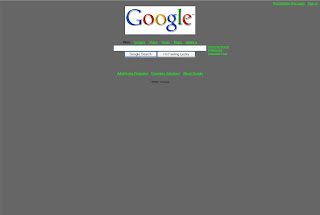 We have the author of the "Black Google" post with us today to answer a few questions, and see where we are headed with this interesting topic.
Mark: Welcome to ecoIron.
Mark: It's good to be here, Mark.
Mark: Let's start off by mentioning that the post was incredibly popular - it was on Digg for a while, then it also appeared on Reddit as well?
Mark: Yes, we got about 40,000 hits yesterday. That's about 400 times what we normally get. Good thing we use Blogger to host this site, it handled the traffic well.
Mark: Why do you think the post was so popular?
Mark: Well, I think that there is some general concern about the greening of the IT world out there, a general sense that all this electronic gadgetry is costing us, as a society, some money, and maybe some other costs as well, such as health and environmental damage. Also, there is a growing awareness that there is a lot of waste in the industry, and that technological solutions can and need to be done smartly, and more efficiently.
Mark: I can certainly see that. Almost every vendor now has some sort of green IT campaign going, and there are a lot of eWaste regulations, such as RoHS and WEEE, that have been passed in recent years. It seems like people are waking up.
Mark: They are waking up, and it's exciting. It's exciting because when you start to look for these solutions, a lot of them are right under your noses. Like the Black Google thing.
Mark: Okay. Now there were a lot of comments on the post, including some that it wouldn't work on LCDs, or was misguided in general. Could you respond to that?
Mark: Sure. A lot of posters responded that the 'color' black costs no energy to produce, or even costs a little energy to produce, on most LCD systems. That's fine, I didn't get any links to any studies on that, but if that is true then that would change things a bit. But, the point is that it would just change. So maybe the most efficient color is not black for a global site like Google - it might be the right color for your Intranet, where you have nothing except CRT monitors. Or, as one poster pointed out, it might be the right thing for TV commercials, broadcasting, where a lot of the receivers are still CRTs. I do disagree with the statement that everyone has a LCD monitor out there, I just don't think that's true. And if so - say there are still 20% CRTs left in the world - then the right, most efficient color is probably a shade a grey. For big sites like Google.
Mark: That's why the background is changed on ecoIron today.
Mark: Right. But I'm tiny. (laughs.)
Mark: Is/should Google going to do anything about this?
Mark: I don't know, and ironically it's not important. I chose Google because it is a high volume site; I could have chosen any site, the site is not important. A lot of readers mentioned that Google would never "go black" because it would be too hard too read, it's not their brand, etc. These are very valid observations which I agree with, it's not so simple. You know, every company has to work within their customers' framework for change, and Google is going to do exactly that. Just like every IT professional who reads this is going to do. That's really the point.
Mark: I completely agree. Anything final words today?
Mark: No, that about covers it. But if there are any studies, or experts on this topic in the audience, I'd love to hear from them. I'd like to pursue this more, come up with more definitive results. Thanks for having me on your blog.
Mark: Great! Thanks for your time.
Saturday, January 20, 2007
Black Google Would Save 750 Megawatt-hours a Year
 As noted, an all white web page uses about 74 watts to display, while an all black page uses only 59 watts. I thought I would do a little math and see what could be saved by moving a high volume site to the black format.
Take at look at Google, who gets about 200 million queries a day. Let's assume each query is displayed for about 10 seconds; that means Google is running for about 550,000 hours every day on some desktop. Assuming that users run Google in full screen mode, the shift to a black background [on a CRT monitor! mjo] will save a total of 15 (74-59) watts. That turns into a global savings of 8.3 Megawatt-hours per day, or about 3000 Megawatt-hours a year. Now take into account that about 25 percent of the monitors in the world are CRTs, and at 10 cents a kilowatt-hour, that's $75,000, a goodly amount of energy and dollars for changing a few color codes.
[ed. This got Dugg. The link to the wattage for different colors is from EnergyStar.]
[ed. There's a follow up as well.]
[ed. And now there's a FAQ too! 7/28/2007.]
[ed. OK seriously, this is the definitive piece on this, very long Wiki-esque post that covers everything to date. 8/6/2007]