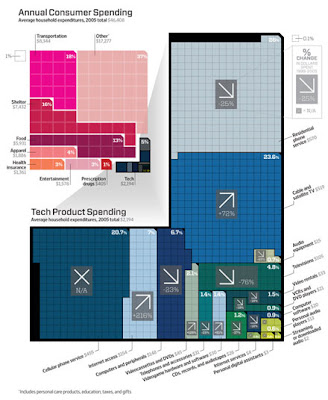
 The Bureau of Labor Statistics has developed this perky graphic to help American chart that on which their tech dollars are blown. Wired noticed that although high tech gear gets cheaper every year, the proportion of the typical US household budget reserved for tech spending has held steady for the past decade. On balance, it's more than what we pay for health insurance, more than prescription drugs, or more than clothing. There's some fun in these numbers.First, they use the term 'televisions', as if it's a given that we all need 4 or 5 of those around at any given time. In fact, this is not too far off; the average US household has about 2.1 per US household. This, coupled with the absurd annual $519 bill for cable TV leads to green tip #1; stop buying TVs and cable service, and invest in a cell phone with either a wind up or solar charger. Alternatively, get a computer and internet service; the access to free green information will serve you better than the canned stuff on TV. Literally, stop thinking about the box.
Second, almost half of the tech budget is used on phone service, the infamous cell phone/land line combo. I understand that people don't feel too good when their cell phone goes dead because the power goes out, but the problem here is that these phones operate on two different systems, and Verizon has already said they are only going to support one of them. An idea; lose the landline. You are going to have to anyway, and you can take that money and put it into green tech like beefy solar chargers and smart strips.:: Fat Knowledge ::Wired
 Leaders do things that are new - they explore the unknown, turn the world on its head, break up old patterns and ways of doing things. For these reasons, leaders are going to catch shrapnel from all angles. In fact, if you want to locate the leader, it's pretty simple; just find the guy taking the most abuse.
Like Apple and their poor iPhone. Oh the abuse! For starters, they are gouging the customer, selling a $220 item for hundreds more. It's been hacked to run on non-ATT networks, and the eWaste reports are already pouring out of the news-o-sphere. And the tiltable screen, where the picture automatically rotates when you turn it sideways, may already be copyrighted by Sony. We can assume they didn't use a mercury switch to implement that little feature, can't we?
Boo hoo, poor little pome. But let's get down to the the green tacks - fact is, the iPhone will be the last phone you will ever buy. You will not trade it in 18 months. It is unlikely you will drop a $600 phone in the toilet. The iPhone and its kind are going to end the planned obsolescence cell phone cycle. That's why Apple is the leader, and that's why the iPhone is great. :: Gizmodo
 I recently suggested that flesh and blood planet dwellers (humans) may soon be competing for resources with electronic machines (computers). A recent report from CNN just drives it home; global mobile phone use will top 3.25 billion users in 2007, mostly due to demand from China, India, and Africa. That's about half the world's population with a cell phone.
The similarities between cell phones and babies are many. They both require you to keep them powered continuously. They both get born - cell phones at about 1000 phones a minute, based on subscriptions and babies at about 180 per minute, over five times slower. Strangely, cell phones are also like babies in that you can have more than one. In fact, over 30 countries already have a saturation rate of over 100 percent, meaning there are more cell phones than people in these countries. Finally, they both seem pretty indispensable; a recent British survey suggested that one third of those polled wouldn't give up their phone for a million pounds. Let's hope they say that about their kids.
Is it a crisis? Well, the average cell phone uses about 3 watts, and there is the power and associated with charging it, the cost of running the towers, and the costs to actually make the phone. The cost of the baby is a few hundred calories a day, plus the caloric manufacturing costs. These facts and figures constitute the typical environmental scenario - small increments that add up big - but unless you are a believer in unlimited energy, the smart bet is the one where we ultimately have to stop making electronics, or babies. : CNN
 This just in from SimplySwitch; a recent study found that a little over a quarter of the 18 million cell phones purchased in the UK end up being lost or damaged every year. Topping the list is dropping the chatter into the crapper; that's right, a staggering 855,000 handsets are flushed down toilets every year. That translates into about £342 million in additional revenue for the cell phone sellers.
Phones in the throne aren't the only problem; other common catastrophes include leaving mobiles in the pub (810,000 handsets) in a taxi (315,000) or on a bus (225,000). Dogs ate another 58,500, and 116,000 went through a spin cycle with the dirty laundry. The finger of blame points at the young - a full 40 per cent of those under 34 admitted to losing or damaging their phone. Don't they know the value of a pound? Or maybe respect for material goods is the issue; try giving your phone a name. Remember, you can't green your electronics when they are in the sewer. :: SimplySwitch
 The Independent has a fairly unnerving story as to how bees may be effected by the radiation given off by mobile phones and other electronic devices. The UK has already been hit hard by Colony Collapse Disorder, and there have been a few theories why this has occured.
The theory in the article is that radiation from mobile phones interferes with bees' navigation systems, preventing them from finding their way back to their hives. Sounds a little buzzy, but there is now evidence to back this up - a former German study found that that bees' behaviour changes near power lines, and this new study discovered that bees refuse to return to their hives when mobile phones are placed nearby. Note that it doesn't prove that cellphones are directly responsible for CCD, but it does provide evidence that mobile phones are implicated in the death of hives.
This might turn out to be a devil's bargain - either give up the cell phones, or give up eating as the world's harvests fail. It's hard to get excited about either option, but if it comes down to it, I would rather eat than talk.
