
In the NYT today for the black web thing, watta trend!

 This one is short and sweet, but it is the first time I have seen a media outlet mention that any site can go black. Thanks Post!
 You might have been following the recent debate about surfing a black web, even received a viral email or two on the topic. We have discussed some facts and figures around using a black Google, and other alternatives sites such as Blackle. In spite of all the recent press, mysteries and myths still abound, here are 5 of the most common.
History
In January 2007, Mark Ontkush, the owner of the ecoIron blog, suggested that a large amount of energy could be saved if Google switched their home page from white to black. The initial savings was estimated to be 3000 Megawatt-hours a year; this was later rounded down to 750 Megawatt-hours, after an error in the calculations was found. At the time, ecoIron was receiving about 100 hits per day. The story was posted on Digg where it rapidly went to #1 on the main page, ultimately receiving over 4,000 Diggs. Tony Heap, the owner of HeapMedia, started the Blackle site shortly after these events.Appearance and Functionality
The Blackle site uses the Google search engine and works in much the same way; users enter text into the box provided, and the query is sent to the Google search engine. The searches both use the same searching algorithm and are executed on the same hardware. However, it has been suggested that the result lists might differ. Blackle uses light grey text on a black background; this is in lieu of the customary Google layout of blue, black, and green text on a white background. Since it is not owned by Google Inc., the Blackle site lacks many of the features of conventional Google, including the 'Cached' and 'Similar Pages' options, and it does not have as many of the corresponding links that can be found on the Google homepage. These links include items such as preferences, advanced search, language tools, images, groups, news and scholar. None of the Blackle links have a visited option, where once a link is followed it turns a different color. The iGoogle feature is also lacking in Blackle.Energy Savings
The principle is based on the the fact that different colors consume different amounts of energy on computer monitors. Depending on the manufacturing technology, and to a lesser degree the brand of the manufacturer, these colors and energy levels vary. An explanation is provided below.Cathode Ray Tube (CRT) Monitors
A CRT monitor uses a cathode ray tube to display images. The back of the tube has a negatively charged cathode, and an electron gun shoots electrons down the tube and onto a charged screen. The screen is coated with a pattern of dots that glow when struck by the electron stream. Each cluster of three dots, one of each color, is one pixel. Certain colors, such as white, require all three dots to be charged, and are energy intensive to display. Other colors, such as black, requires no additional energy to produce and consume the least out of all the colors.As such, LCD display technology is different from CRT technology, and the possibility exists that colors that are energy efficient to display on a CRT monitor (e.g. black) may not be as energy efficient to display on an LCD monitor. The Roberson study found that LCD monitors saved up to 3W by switching from a white to a black screen, and in no case did any of the LCD monitors use more energy displaying black than white. Recently, several informal studies have been done, with results ranging from a 2W reduction when displaying Blackle vs Google on an IBM Thinkvision LCD, to zero, up to a 1W increase.
Display Search estimated in Q12006 that LCD monitors have 74.7% penetration rate worldwide. Japan is the country with the highest rate; 99.3% of their monitors use LCD technology.
Plasma DisplaysA plasma display panel (PDP) is a type of flat panel display commonly used for large TV displays, typically above 37" (940 mm). Many tiny cells located between two panels of glass hold an inert mixture of noble gases (neon, which are contained in hundreds of thousands of tiny cells positioned between two plates of glass. electrodes are sandwiched between the glass plates, in front of and behind the cells. Control circuitry charges the electrodes that cross paths at a cell, creating a voltage difference between front and back and causing the gas to ionize and form a plasma; as the gas ions rush to the electrodes and collide, photons are emitted. To erase a cell, all voltage is removed from a pair of electrodes.Every pixel is made up of three separate subpixel cells, each with different colored phosphors. One subpixel has a red light phosphor, one subpixel has a green light phosphor and one subpixel has a blue light phosphor. These colors blend together to create the overall color of the pixel. Plasma displays use the same phosphors as CRTs, and are bright, 1000 lux or higher being the norm.
Plasma displays use as much power per square meter as a CRT, and consumption varies greatly
depending on what is watched on it. Bright scenes (say a football game) will draw significantly more power than darker scenes (say a movie scene at night). Nominal measurements indicate 400 watts for a 50" screen.
Currently, plasma displays are not popular for computer monitors. However, since they operate similarly to CRT technology, the energy differentials are similar. A study conducted by G4TechTV using a Samsung 42" plasma display found a 191W differential for a white vs. black screen in normal mode, and a 138W differential in super energy savings mode. Plasma displays are particularly well suited for the large displays, outpacing other types of display technologies. However, recent improvements in LCD technology have contributed to falling prices, higher resolutions, and often lower electrical power consumption, making them very competitive against plasma displays.
As of late 2006, analysts note that LCDs are overtaking plasmas, particularly in the important 40" (1.0 m) and above segment where plasma had previously enjoyed strong dominance a couple of years before.
OLEDAn organic light-emitting diode (OLED) is any light-emitting diode (LED) whose emissive electroluminescent layer comprises a film of organic compounds. The layer usually contains a polymerpixels can emit light of different colors. substance that allows suitable organic compounds to be deposited. They are deposited in rows and columns onto a flat carrier by a simple "printing" process. The resulting matrix of OLEDs are used in television screens and computer displays; a great benefitof OLED displays over traditional liquid crystal displays (LCDs) is that OLEDs do not require a backlight to function. Thus they draw far less power and, when powered from a battery, can operate longer on the same charge. No comprehensive studies have been conducted of a comparison a white vs. black screens, but due to the nature of their construction, it is probable that displaying white
consumes more energy than black on a OLED device.
The effectiveness of using the 'black web' technique to save energy is a subject of intense debate, much of which centers on the pros and cons of a specific implementation, and the scale at which the approach is implemented. Other discussions are focused on the amount of energy saved, both individually and collectively, and the trade-offs involved in implementing a solution of this type. A summary of the different approaches is provided below.
Governmental/Corporate PolicyOne approach is to modify a color scheme of incoming web traffic at a high level, such as the corporate or country level. In this case, an entity with a large number of CRT monitors might intervene on their users' behalf to convert the color codes as they travel through the network, thereby producing a uniform color scheme for the entity as a whole. To date, there have been no reported implementations of this strategy. However, countries such as China or Brazil, who demonstrably have a large number of CRT monitors could save significant energy.
Single SiteThis approach relies on a particular web site to change their primary color scheme; the net energy savings or loss can then be calculated by estimating four parameters:
In July 2007, the Financial Times reported that, according to the Nielsen/NetRatings for May, users spent 2,557,000,000 minutes on Google websites; this translates into 511,400,000 hours of Google website use per year. The monthly figures for Yahoo (746M) , MySpace (7,535M), and YouTube
(2,117M) are comparable.
Another approach is to use a third party site to implement some functionality of an existing site, and then use an alternative color scheme. This is the approach used by Blackle and similar sites to mimic
the Google site. In this case, users must deliberately use the alternative site instead of Google's home page.
Individual Efforts
Criticisms
There has been both praise and criticism for this initiative, with its supporters citing it as a great example of environmental thinking, and its detractors pointing out usability and aesthetic problems, as well as questions about the scientific validity of the claims. Some of the issues are listed below. Of course, I have been following the black Google thing religiously the last few days. Some think it's great. Some still think it doesn't save any energy, even testing their monitor and proving the theory with an n of 1. And there are some pushbackers, as if mandating the viewing of black web pages is akin to sawing off their left arm. Good thing I didn't propose that China or Brazil, both countries with a lot of CRT monitors, mandate that all web traffic be black... oops!
Rms: So this shows how people take flimsy invalid excuses and stretch them to excuse doing what they want to be doing (because it's the usual way or whatever). It's a common practice when using non-free software, and that's our biggest obstacle: social inertia.I'm not bashing Rory (or anyone else) here, I think what he said is spot. But it seems to be that solving the Internet energy problem by implementing the black web is very similar to trying to solve the bad gas, climate change problem; everyone knows what to do, they just don't want to do it. Solve the web energy problem, and we will be well on our way to solving the climate change problem.
So how do we overcome social inertia?
Well the first step is to recognize it, and to show how is not valid. People want to give into social inertia because it's easy. But they don't want to say, "I want to do the wrong thing because it’s easier for me to do the wrong thing." So they exaggerate - they say doing the right thing is simply impossible. Impossible they say. Intolerable. It's always a matter of exaggeration, often several steps of exaggeration in series. So whenever I hear that, I start pointing out why it’s fallacious.
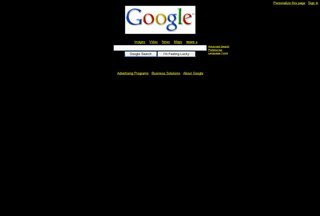 I can see from my hit counter that Black Google is making the rounds again. It's interesting; this is the third time the Black Google wave has crashed over the world. Since some of the facts get tangled every time, I thought I would do a little Q&A on the topic.
 A short post to inform all the commenters that said I should redesign my site, that I am, in fact, going to redesign my site. I'm not giving it away, but here's a hint.
 I got hundreds of comments on the "Black Google" post. First, thanks for posting. I'm sorry I couldn't get back to every person individually.
 I think we have it. DisplaySearch has a table on LCD monitor penetration rates by region, which we can use to adjust our "Black Google" number. The table is interesting in itself, indicating over 99 percent LCD penetration in Japan, and only 37.2 percent in Latin America. Worldwide, as of first quarter 2006, they estimate LCD penetration at 74.7 percent.